
MAHA Games Self Exclusion India Options
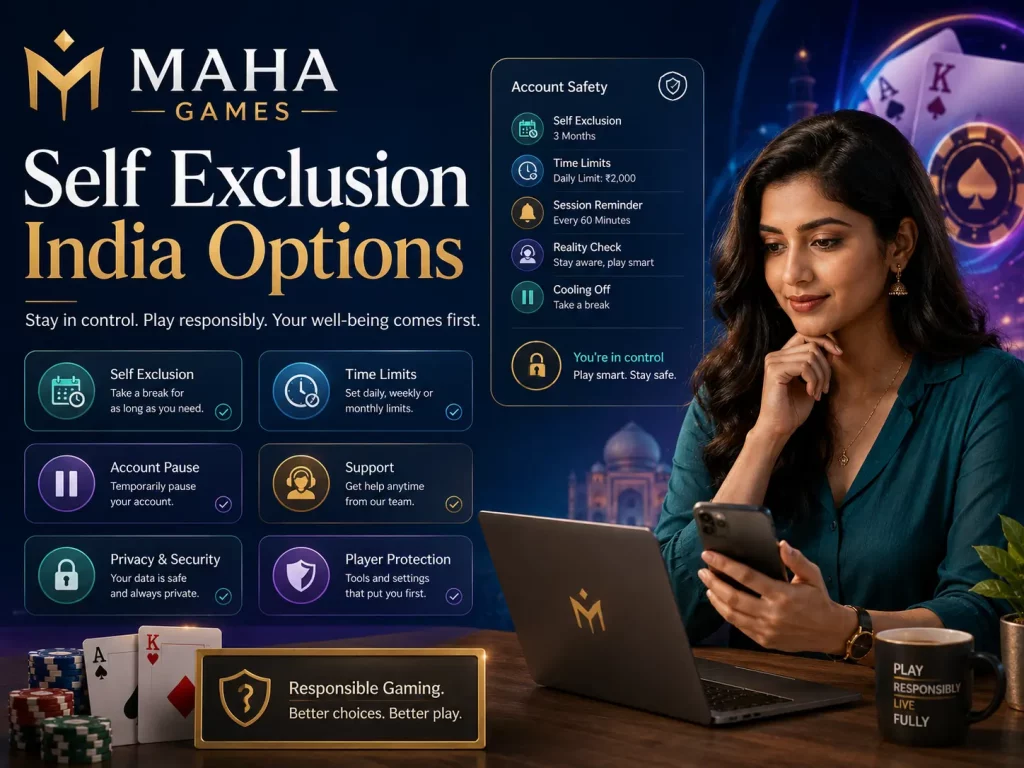
Self-exclusion is one of the most important tools for maintaining control over online gaming activity. In India, where mobile-first entertainment platforms are rapidly growing, responsible gaming systems are becoming essential for player safety and long-term trust. This guide is designed for users of MAHA Games and explains how self-exclusion works, why it matters, and what options are typically available.
Self-exclusion is not about punishment or restriction—it is about giving players the ability to pause, limit, or fully stop access to gaming services when they feel it is necessary. Whether someone wants a short break or a long-term restriction, modern platforms provide flexible tools to support healthier habits.
Understanding Self-Exclusion in Online Gaming
Self-exclusion is a voluntary action taken by a user to block or limit access to gaming services for a chosen period of time. It is commonly used when players feel:
- Gaming is becoming too frequent
- Spending is harder to control
- Emotional stress is connected to gameplay
- A temporary or permanent break is needed
On platforms like MAHA Games, self-exclusion tools are designed to be simple, accessible, and effective. They are part of a broader responsible gaming framework that ensures users stay in control of their experience.
Self-exclusion usually comes in different durations:
- 24 hours or short cooling-off periods
- 7 days or weekly breaks
- 30 days or monthly pauses
- 6 months or long-term exclusion
- Permanent account closure
These options allow flexibility depending on user needs.
Why Self-Exclusion Matters
Online gaming platforms operate in a fast-paced digital environment. Features such as instant deposits, mobile access, and continuous gameplay can sometimes lead to excessive usage if not managed properly.
Self-exclusion helps by:
- Interrupting impulsive behavior
- Creating healthy breaks
- Reducing financial risk
- Encouraging responsible habits
- Supporting mental well-being
Many users only realize the importance of self-exclusion after experiencing burnout or overspending. That is why platforms like MAHA Games integrate it as a core feature rather than an optional add-on.
Common Self-Exclusion Tools Available
Most modern gaming platforms provide several layers of control. These tools are often found in account settings or responsible gaming sections.
Typical tools include:
- Deposit limits
- Session time limits
- Temporary account suspension
- Full self-exclusion mode
- Reality check reminders
These tools work together to help users manage their behavior before it becomes problematic.
Overview of Self-Exclusion Options
| Type | Duration | Best For |
|---|---|---|
| Cooling-Off | 24–72 hours | Short break after intense activity |
| Temporary Pause | 7–30 days | Reset gaming habits |
| Long-Term Exclusion | 6+ months | Break dependency patterns |
| Permanent Closure | Indefinite | Complete exit from platform |
Integration of Responsible Gaming in MAHA Games
Modern gaming ecosystems are built with responsible gaming as a core principle. On platforms like MAHA Games, self-exclusion is integrated into account settings so users can activate it without contacting support.
The system typically includes:
- Instant activation for cooling-off periods
- Mandatory confirmation steps for long exclusions
- Locked reversal periods for safety
- Support links for assistance
This ensures that decisions made during emotional moments are still protected by system safeguards.
User Journey and Access Points
Self-exclusion tools are usually located in predictable areas of a gaming platform interface:
- Account settings section
- Responsible gaming menu
- Profile management dashboard
Users typically go through a simple flow:
- Open account settings
- Select responsible gaming
- Choose exclusion type
- Confirm duration
- Receive confirmation message
This simplicity is intentional—it ensures accessibility even for less experienced users.
Key Digital Elements in Gaming Platforms
In addition to self-exclusion, gaming platforms often include supporting features that help users manage their experience more effectively.
These include:
- Login security verification
- Sign up identity checks
- Bonus tracking controls
- Apk mobile access restrictions
- Games session timers
- Slots behavior limits
- Links to support resources
Each of these elements contributes indirectly to safer gaming behavior by increasing transparency and control.
Why Players Choose Self-Exclusion
Most users do not activate self-exclusion randomly. It usually happens after repeated behavioral signals or emotional triggers.
Common reasons include:
- Loss of control over time spent gaming
- Chasing losses after unsuccessful sessions
- Emotional stress or frustration
- Financial overextension
- Lack of healthy breaks between sessions
In many cases, users initially try smaller tools like limits or reminders before moving to full exclusion.
Behavioral Triggers in Online Gaming
Understanding triggers helps explain why self-exclusion exists in the first place. Online gaming platforms are designed to be engaging, which can sometimes lead to overuse if not balanced properly.
Key triggers include:
- Fast reward cycles (wins/losses in seconds)
- Continuous gameplay loops
- Mobile accessibility at any time
- Bonus incentives and promotions
- Emotional decision-making after losses
These triggers do not mean gaming is harmful by default—they simply highlight why structured control tools are necessary.
Self-exclusion is the strongest form of control, but it is part of a broader system. Most platforms provide layered tools so users can choose the right level of restriction.
Gaming Control Tools Comparison
| Tool | Control Level | Purpose | Flexibility |
|---|---|---|---|
| Deposit Limits | Low | Control spending per day/week | High |
| Session Timers | Medium | Limit play duration | Medium |
| Cooling-Off Mode | High | Short-term break from gaming | Low |
| Self-Exclusion | Very High | Full account restriction | Very Low |
How Self-Exclusion Impacts User Behavior
When a player activates self-exclusion, the psychological effect is often immediate. It creates a forced distance between the user and gaming environment.
Typical outcomes include:
- Reduced impulsive decision-making
- Break in emotional cycles linked to gaming
- Improved financial awareness
- Time recovery for other activities
- Reduced dependency on instant rewards
The key effect is not restriction—it is reset.
Emotional Patterns Behind Gaming Behavior
Many users experience emotional patterns that influence gaming decisions. These patterns often repeat in cycles:
- Excitement → engagement begins
- Loss → frustration increases
- Chase behavior → attempt to recover losses
- Overuse → extended sessions
- Regret → decision to take a break
Self-exclusion interrupts this cycle at the most critical point.
Behavioral Risk Trend
Before & After Self-Exclusion
Lower values indicate improved control and reduced behavioral risk.
Platform Responsibility and User Safety
Modern gaming platforms are required to integrate responsible gaming tools not just as features, but as core compliance systems. On platforms like MAHA Games, this includes:
- Transparent access to self-exclusion settings
- Clear warnings before activation
- Secure confirmation steps
- Protection against immediate reversal
- Dedicated support for users in exclusion mode
These safeguards ensure that decisions are respected and not easily reversed under emotional pressure.
Digital Ecosystem Elements (How Everything Connects)
Self-exclusion is connected to multiple system layers inside gaming platforms:
- Login authentication prevents unauthorized re-entry
- Sign up systems store responsible gaming preferences
- Bonus systems are paused during exclusion periods
- APK mobile access is restricted or disabled
- Games and slots access is fully blocked
- Links to support resources remain available
Each layer reinforces the exclusion effect across the platform.
How Self-Exclusion Becomes a System-Wide Action
When a user activates self-exclusion, the platform does not simply block a single function. Instead, it triggers a synchronized update across multiple subsystems. This update changes the user’s account state at a foundational level, meaning every connected service must immediately respond to the new restriction status.
At the authentication level, login attempts are validated against an exclusion flag stored in secure backend databases. If the flag is active, the system prevents session creation entirely, regardless of whether credentials are correct. This ensures that excluded users cannot bypass restrictions through normal entry points.
At the same time, wallet systems, game engines, and promotional modules are notified of the updated status. Each subsystem then adjusts its behavior accordingly, effectively turning the account into a read-only or fully restricted state depending on the exclusion type selected.
This multi-layer enforcement is what distinguishes modern responsible gaming systems from simple account suspension tools.
How Platform Modules Respond to Exclusion
| Platform Module | System Behavior | User Impact |
|---|---|---|
| Authentication Layer | Blocks session creation | User cannot log in |
| Game Engine | Disables gameplay requests | Slots and games become inaccessible |
| Wallet System | Freezes transactions | No deposits or betting activity |
| Bonus Engine | Suspends rewards logic | Promotions temporarily inactive |
| Support Layer | Remains active | User can still seek assistance |
Why Multi-Layer Enforcement Is Necessary
The reason self-exclusion systems use multiple enforcement layers is to eliminate dependency on any single control point. If restrictions existed only at the login stage, for example, alternate access methods could potentially bypass them. Similarly, if only the game engine was restricted, account-level activity might still continue.
By distributing enforcement across authentication, wallet processing, and game execution systems, the platform ensures that exclusion is not just a feature—it becomes a persistent state.
This design is particularly important in mobile-first environments, where users may access services from different devices, networks, or application versions. A centralized exclusion state ensures synchronization across all entry points.
Behavior of Systems During Active Exclusion
Once self-exclusion is active, the system enters a stable enforcement mode. This means restrictions are not repeatedly recalculated; instead, they are maintained through a persistent account flag.
In practice, this reduces system complexity while increasing reliability. Every incoming request from an excluded account is checked against this flag before any further processing occurs. If the flag indicates restriction, the request is immediately terminated.
This approach also improves transparency, because it creates a predictable user experience: access is either fully available or fully restricted, depending on account status.
System Design Philosophy Behind Self-Exclusion
The design philosophy behind self-exclusion systems is based on one core principle: reducing reliance on user decision-making during high-emotion states. Instead of expecting users to repeatedly choose restraint, the system enforces that restraint automatically once activated.
This shifts responsibility from moment-to-moment decision-making to a structured environment where boundaries are already defined and enforced. It also reduces cognitive load on users, which is particularly important in high-engagement digital environments where impulsive behavior is common.
On platforms like MAHA Games, this philosophy is reflected in how deeply integrated self-exclusion is across all functional modules, rather than being treated as an isolated setting.
Self-Exclusion System Lifecycle
Restriction Intensity by Stage
What Happens After Self-Exclusion Ends
When a self-exclusion period expires, access to the account is not always restored instantly without conditions. Many modern gaming systems include a structured reactivation flow to ensure that users return consciously rather than impulsively.
In most systems, reactivation may involve:
- Login re-verification through secure credentials
- Confirmation of intent to return
- Review of responsible gaming settings
- Optional reset of deposit or session limits
- Cooldown reminders before full access restoration
This approach ensures that the transition from restriction to activity is controlled and intentional.
Reactivation vs Permanent Closure
Not all self-exclusion actions are reversible in the same way. Short-term exclusions typically allow automatic return after the timer ends, while long-term or permanent exclusions may require additional verification or may not be reversible at all.
The key difference lies in intent: temporary exclusions are designed for behavioral breaks, while permanent exclusions are designed for full disengagement from the platform.
Understanding this distinction helps users choose the right option from the beginning.
Responsible Gaming After Return
After reactivation, platforms encourage users to set boundaries immediately. This is a critical moment because it defines whether old patterns reappear or whether new habits are formed.
Common recommended practices include:
- Setting deposit limits before first session
- Activating session reminders
- Avoiding high-frequency gameplay sessions
- Using bonus features cautiously
- Monitoring emotional triggers during play
These measures are not restrictions—they are preventive tools designed to maintain balance.
Post Self-Exclusion Recovery Flow
| Stage | System Action | User Experience |
|---|---|---|
| Exclusion End | Account status unlocked | User regains login access |
| Reactivation Check | Identity & intent verification | User confirms return decision |
| Safety Reset | Optional limit configuration | User sets new boundaries |
| Controlled Access | Monitoring enabled | Gameplay resumes with safeguards |
| Long-Term Stability | Behavior tracking active | User maintains balanced gaming habits |
Long-Term Responsible Gaming Strategy
Sustainable gaming behavior depends on consistency rather than short-term control. Once users return after self-exclusion, the goal is not to eliminate gaming, but to integrate it into a balanced routine.
This includes developing awareness of time spent, financial limits, and emotional triggers. Platforms support this by offering built-in tools, but long-term success depends on user behavior patterns outside the system as well.
Platform Ecosystem Integration
Modern gaming platforms integrate self-exclusion with multiple ecosystem components to ensure consistent behavior across all features.
This includes:
- Login systems that preserve user restriction history
- Sign up systems that enforce responsible gaming defaults
- Bonus systems that adapt to user risk profile
- APK mobile apps that sync exclusion states instantly
- Games and slots modules that respect account status
- Links and support systems that remain accessible during restriction
This creates a unified environment where user safety settings are always respected across devices and access points.
Self-exclusion is a structured safety mechanism designed to support long-term responsible gaming behavior. Across platforms like MAHA Games, it functions not as a limitation, but as a controlled pause that helps users reset habits, regain balance, and return with clearer boundaries.
When combined with post-exclusion safeguards, reactivation flows, and ongoing responsible gaming tools, it becomes part of a complete ecosystem focused on user well-being rather than short-term engagement.
This completes the full guide to Self Exclusion India Options.
Self-Exclusion FAQ – India Players
What is self-exclusion in MAHA Games?
Self-exclusion is a responsible gaming tool that allows users to temporarily or permanently block access to their account. It helps players take a break and control their gaming activity.
Can I cancel self-exclusion early?
In most cases, short cooling-off periods cannot be canceled. This is designed to prevent impulsive decisions. Longer exclusions may require verification before reactivation.
What happens to my Login and Sign up access?
During self-exclusion, Login access is blocked and the account cannot be used. Sign up remains available for new users, but excluded accounts stay restricted until the period ends.
Do Bonuses, Games, and Slots still work?
No. All Bonus features, Games, and Slots are disabled during self-exclusion to ensure full restriction and prevent access to gambling features.
Can I access MAHA Games APK during exclusion?
The APK may still open, but all restricted features remain locked. The system enforces self-exclusion at the account level, not just the app level.
Are Links and support still available?
Yes. Support Links remain active so users can always contact assistance, even during self-exclusion periods.






Comments