
MAHA Games Volatility Explained India Players
In modern online gaming ecosystems such as MAHA Games, volatility is one of the core mathematical systems that defines how gameplay feels, how rewards are distributed, and how players experience risk over time. For India players especially, understanding volatility is essential because it directly influences session planning, bankroll management, and overall satisfaction with gameplay outcomes.
Volatility does not determine whether a game is fair or unfair. Instead, it defines the distribution pattern of wins. This means that two players can play the same game with identical RTP conditions, but experience completely different short-term results due to volatility structure.
At its simplest level:
- Volatility = how often wins happen and how big they are
- RTP = long-term return percentage
- RNG = system that generates random outcomes
These three elements work together to create the gameplay experience on MAHA Games.
How Volatility Works in Real Gameplay
To understand volatility practically, imagine two different game models:
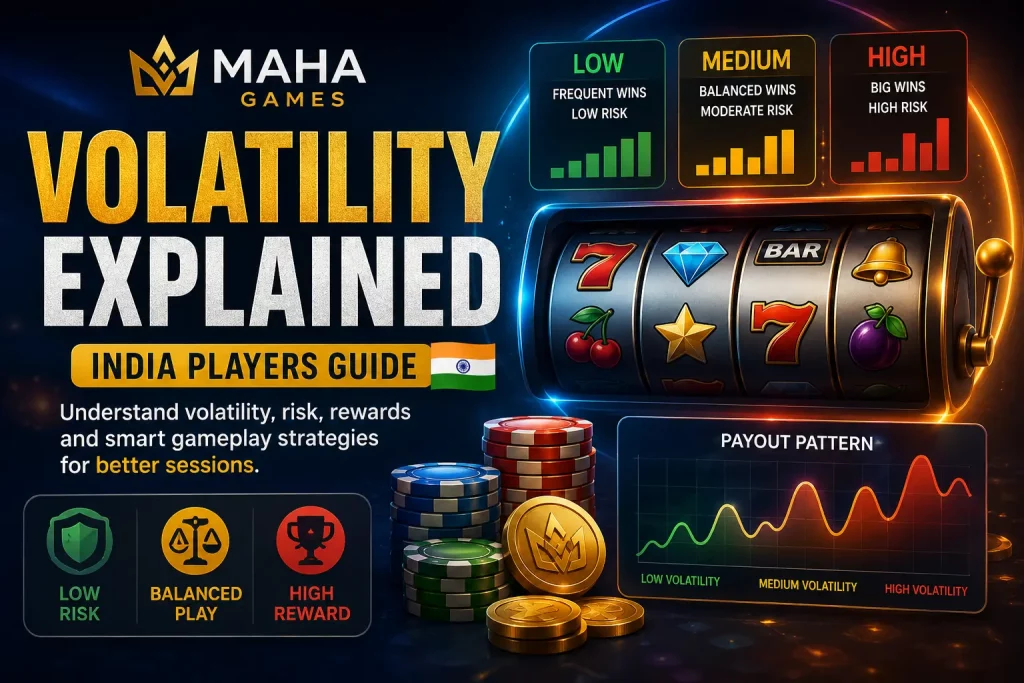
A low volatility system produces frequent small wins. Players feel constant feedback, which creates a sense of stability and extended playtime.
A high volatility system produces rare but significantly larger wins. This creates tension, anticipation, and high emotional spikes during gameplay.
Medium volatility sits between these two, balancing consistency and excitement.
Importantly, volatility does not change the fairness of the game. It only reshapes how results appear over time.
Accessing Games and Platforms
Before starting gameplay, users usually go through Login or Sign up processes. These steps ensure secure access to personal accounts, game history, and reward systems. Once inside, players can explore different categories such as Slots, where volatility levels often vary significantly between titles.
For mobile users, many platforms also offer an APK version, allowing direct installation on Android devices without using traditional app stores. This can improve accessibility and performance for users in regions with limited store availability.
Game Access and Navigation Links
Modern platforms often organize their content through dedicated Links sections, making it easier to navigate between games, promotions, and account features. These links help players quickly switch between different slot categories, volatility types, or bonus pages without losing progress.
Why India Players Should Understand Volatility
For India-based players, volatility plays an even more important role because gaming behavior tends to vary widely across different user types:
- Casual users prefer short sessions and predictable outcomes
- Regular users want balanced gameplay with moderate risk
- High-risk users seek large reward potential even with uncertainty
Because of this diversity, MAHA Games integrates multiple volatility levels across its game portfolio to match different expectations.
Understanding volatility helps players:
- Avoid unrealistic expectations
- Choose games that match their style
- Manage session length more effectively
- Reduce frustration caused by misunderstanding randomness
Volatility vs Perception of Fairness
One of the most important psychological effects in gaming is that players often confuse volatility with fairness.
For example:
- A low volatility game feels “fair” because wins happen often
- A high volatility game may feel “unfair” because wins are rare
However, both systems can have identical RTP and identical fairness structure. The difference lies only in how results are distributed over time.
This is why MAHA Games focuses heavily on transparency and clear system explanations.
Core Volatility Types
In most modern game systems, volatility is divided into three primary categories:
Low Volatility
- Frequent wins
- Smaller reward amounts
- Longer stable gameplay sessions
- Lower emotional risk
Medium Volatility
- Balanced win frequency
- Moderate reward scaling
- Most popular among general players
- Stable engagement curve
High Volatility
- Rare wins
- Large payout potential
- High excitement and unpredictability
- Suitable for risk-oriented players
Each type serves a different psychological and strategic purpose.
Volatility Overview
| Type | Win Frequency | Payout Size | Player Experience |
|---|---|---|---|
| Low Volatility | High | Small | Stable and predictable gameplay |
| Medium Volatility | Balanced | Moderate | Balanced excitement and control |
| High Volatility | Low | Large | High-risk, high-reward experience |
Early Insight for Players
The key takeaway for India players is that volatility should not be treated as a prediction system. It is not about increasing chances of winning—it is about understanding how wins are distributed over time.
Players who misunderstand volatility often experience frustration during short sessions, especially in high volatility games where long dry periods are normal.
On the other hand, players who understand volatility are able to adjust expectations and choose games more strategically.
Player Psychology and Volatility Perception (India Players)
Volatility is not only a mathematical system inside MAHA Games—it is also a psychological experience layer that shapes how players feel about wins, losses, and progress over time. Two players can play the same game with identical RTP and RNG conditions, yet interpret the experience completely differently depending on volatility structure.
For India players, this psychological effect is especially strong because gaming sessions are often short, emotionally reactive, and influenced by expectation cycles. Volatility becomes the hidden force that controls pacing, tension, and reward satisfaction.
When volatility is low, the brain receives frequent feedback. This creates a sense of stability and control. When volatility is high, the brain experiences longer gaps between rewards, followed by intense emotional spikes when wins finally occur. Medium volatility sits between these two extremes, balancing emotional rhythm.
How Volatility Shapes Emotional Flow
Instead of thinking of volatility as a technical parameter, it is more accurate to understand it as an emotional pacing system.
In low volatility environments, players tend to feel:
- Continuous engagement
- Reduced frustration
- Predictable reward rhythm
In high volatility environments:
- Anticipation builds over time
- Emotional spikes are stronger
- Sessions feel more “dramatic” and unpredictable
Medium volatility produces a mixed emotional curve, often preferred by regular MAHA Games users because it avoids both boredom and extreme uncertainty.
The key insight is that emotion does not depend on total winnings alone—it depends on timing of wins, which is controlled by volatility.
Misinterpretation Problem Among Players
One of the most common misunderstandings is that players judge fairness based on short-term outcomes. If a player experiences several losses in a row, they may assume the system is unfair or unbalanced. However, this is often simply the natural behavior of higher volatility systems.
In reality, volatility does not change fairness or RTP. It only changes distribution timing.
This is why MAHA Games emphasizes transparent systems and clear progression logic—so players can better understand that variance is expected, not unusual.
Behavioral Cycle of India Players
Most India players follow a repeating engagement cycle during gameplay sessions:
- Initial curiosity and excitement
- Early results interpretation
- Emotional reaction to variance
- Adjustment of expectations
- Decision to continue or pause session
Volatility strongly influences how fast players move through these stages. Low volatility keeps players in a stable emotional state for longer periods. High volatility accelerates emotional transitions, often leading to more intense reactions.
Psychological Stability vs Reward Intensity
There is a natural trade-off between stability and excitement in game design.
Low volatility prioritizes stability. Players feel in control, but excitement is limited. High volatility prioritizes excitement, but introduces uncertainty and emotional swings.
Medium volatility attempts to optimize both, which is why it is widely used in balanced game categories within MAHA Games.
Emotional Response by Volatility
| Volatility Level | Emotional Pattern | Engagement Style | Risk Perception |
|---|---|---|---|
| Low | Stable and predictable | Long continuous play | Low perceived risk |
| Medium | Balanced emotional rhythm | Moderate engagement cycles | Controlled risk awareness |
| High | High spikes and drops | Short intense sessions | High perceived risk |
Emotional Intensity Levels
Understanding psychological response helps explain why players often prefer different game types even when statistical returns are similar. Volatility does not change long-term math, but it completely changes moment-to-moment emotional experience.
This is why platform design focuses not only on fairness, but also on experience balance—ensuring that players can find a volatility level that matches their emotional preference.
Volatility Strategy & Bankroll Management (India Players)
When players move from understanding volatility into actual gameplay behavior, the focus shifts from theory to strategy. In MAHA Games, volatility does not just define emotional experience—it directly influences how players should structure their sessions, manage their bankroll, and decide when to continue or pause.
A key mistake many India players make is treating volatility as a signal for “when to win.” In reality, volatility only defines how results are distributed across time, not when specific outcomes will occur. Because of this misunderstanding, players often misjudge session length and overestimate short-term predictability.
In practical terms, volatility becomes a planning tool. It helps players decide how long they should play, what risk level they are comfortable with, and what type of game structure matches their budget.
Low volatility environments are usually preferred for longer sessions because they create consistent feedback loops. Medium volatility is often used by players who want a balance between stability and excitement. High volatility is chosen by players who accept longer dry periods in exchange for the possibility of large wins.
Bankroll Logic and Volatility Relationship
Bankroll management is deeply connected to volatility behavior. A small bankroll is more sensitive to variance, which means players naturally gravitate toward lower volatility games to extend playtime.
A larger bankroll allows players to absorb longer variance cycles, making high volatility more suitable. However, this does not increase winning probability—it only changes how long a player can remain in the game before emotional or financial limits are reached.
In MAHA Games, this relationship is designed to ensure that all volatility levels remain accessible, but each requires different psychological preparation.
Strategy vs Volatility
| Player Goal | Recommended Volatility | Bankroll Style | Session Behavior |
|---|---|---|---|
| Long Playtime | Low | Conservative | Extended stable sessions |
| Balanced Experience | Medium | Moderate control | Flexible engagement |
| High Reward Potential | High | Aggressive tolerance | Short high-risk sessions |
Why Strategy Fails Without Volatility Understanding
Many players assume strategy alone determines success, but without understanding volatility, strategy becomes incomplete. For example, increasing bet size in a high volatility environment does not increase win frequency—it only increases exposure to variance.
Similarly, switching from one volatility type to another mid-session can completely change emotional pacing, leading players to misinterpret natural variance as system inconsistency.
This is why MAHA Games emphasizes education around volatility as part of responsible gameplay structure.
Player Distribution by Volatility Preference
Volatility is not a prediction tool, but a structural behavior model that defines how risk unfolds over time. Players who align strategy with volatility behavior tend to have more stable sessions and more predictable emotional experiences.
In MAHA Games, this alignment is essential because it ensures that gameplay remains engaging without creating false expectations about short-term outcomes.
Advanced Volatility Systems, Transparency
At the most advanced level of MAHA Games, volatility is no longer just a static gameplay parameter. It becomes part of a layered system that interacts with game balancing logic, reward distribution models, and long-term player engagement design. This is where volatility shifts from a simple concept into a dynamic framework that shapes the entire ecosystem experience.
For India players, this matters because it explains why outcomes can feel consistent across long periods even when short-term results appear unpredictable. The system is built to maintain fairness while still delivering varied emotional pacing across sessions.
Volatility in modern systems is not isolated. It is connected to RNG behavior, RTP balancing, session timing logic, and player retention models. Together, these elements ensure that gameplay remains statistically stable while still feeling engaging and unpredictable in the short term.
How Advanced Volatility Systems Work
Instead of using a single fixed volatility model, advanced platforms like MAHA Games often distribute volatility behavior across multiple layers of gameplay:
- Game-level volatility (overall structure)
- Feature-level volatility (bonus rounds, special triggers)
- Session-level variance (short-term fluctuation patterns)
This layered approach ensures that no single factor fully determines the player experience. Instead, volatility is distributed across different systems that interact with each other over time.
For players, this means that two sessions in the same game can feel different depending on which internal systems are activated during that period.
Importantly, this does not change fairness. It only changes distribution timing and intensity of outcomes.
Transparency and Player Trust Systems
One of the most important developments in modern gaming ecosystems is transparency tooling. MAHA Games integrates structured visibility systems that help players understand long-term behavior patterns rather than focusing only on short-term outcomes.
These systems may include:
- Historical payout distributions
- Session-based performance tracking
- Statistical fairness summaries
The purpose is not to predict outcomes, but to show that volatility operates within controlled mathematical boundaries.
This reduces misinterpretation, especially during high volatility sessions where long gaps between wins can otherwise feel confusing to players.
Volatility System Layers
| System Layer | Function | Impact on Gameplay | Player Effect |
|---|---|---|---|
| Game-Level Volatility | Defines base risk-reward structure | Overall win distribution | Core gameplay style |
| Feature-Level Volatility | Controls bonus mechanics | Spikes in reward moments | Excitement bursts |
| Session-Level Variance | Short-term randomness shaping | Win/loss streaks | Emotional fluctuations |
The most important takeaway is that volatility should never be interpreted as a signal of “when to win.” Instead, it should be understood as a structural rhythm that shapes the flow of gameplay over time.
Players who misread volatility often experience frustration during normal variance cycles, especially in high volatility environments where reward gaps are naturally longer. In contrast, players who understand volatility tend to have more stable expectations and better session control.
This difference in understanding often separates casual emotional reactions from strategic gameplay awareness.
Volatility in MAHA Games is a foundational system that connects mathematics, psychology, and gameplay design into one unified structure. It does not determine individual outcomes but defines how those outcomes are experienced over time.
For India players, understanding volatility leads to:
- More stable expectations
- Better session planning
- Reduced emotional misinterpretation
- Improved long-term engagement quality
Ultimately, volatility is not about winning or losing—it is about how the journey of gameplay is shaped from start to finish.
FAQ — Volatility Explained
What does volatility mean in MAHA Games?
Volatility defines how wins are distributed over time. It does not change fairness or RTP. Instead, it controls whether wins appear frequently in small amounts or rarely in larger amounts.
Is high volatility better for winning more money?
High volatility does not increase win probability. It only increases the range of outcomes. This means longer gaps between wins, but potentially larger payouts when wins occur.
Why do low volatility games feel more stable?
Low volatility games produce frequent small wins, which creates a steady feedback loop. This makes gameplay feel more predictable and emotionally stable over short sessions.
Does volatility affect RTP or fairness?
No. Volatility does not affect RTP or fairness. RTP defines long-term return, while volatility defines how results are distributed over time.
Which volatility level is best for beginners?
Beginners usually prefer low or medium volatility because it provides more stable gameplay and reduces the impact of long losing streaks.






Comments